Supreme Court Strikes Down Louisiana Abortion Restriction

In a victory for abortion access, the U.S. Supreme Court ruled today in June Medical Services v. Russo that Louisiana could not require abortion providers to have admitting privileges at a local hospital. The ruling upholds an earlier Supreme Court decision, Whole Women’s Health v. Hellerstedt, which struck down a similar Texas law because it placed on undue burden upon those seeking abortion care. While the Louisiana law was virtually identical to the Texas law, which was struck down in 2016, it was not a forgone conclusion that the Supreme Court—with the subsequent appointments of Justices Neil Gorsuch and Brett Kavanaugh to the bench–would uphold the precedent.

If the law that was struck down today had been allowed to go into effect, Louisiana would have had only one abortion clinic in the entire state. This would have effectively left many people without access to an abortion provider, especially groups already marginalized: Black people, people with disabilities, the LGBTQ+ community, young people, and low income individuals. Today’s decision calls into question the constitutionality of a broad range of needless and arbitrary abortion restrictions, often referred to as targeted reductions of abortion providers (TRAP) laws. Numerous states, not just Texas and Louisiana, have passed TRAP laws in recent years in an effort to curb abortion access.

Jennie Wetter, the Population Institute’s director of public policy, said: “While today’s decision is a victory for reproductive rights, too many people still lack effective access to abortion services. A wide range of restrictions have been placed in the way of obtaining an abortion and clinics in many states have been forced to close for a variety of reasons making abortion even harder for people to access. Which means despite this favorable decision, the battle over abortion access is far from over and we will keep fighting until abortion is available and affordable to all.”

The Population Institute has endorsed the Blueprint for Sexual and Reproductive Health, Rights, and Justice which lays out a proactive policy agenda that includes as a core tenet that every individual must have unimpeded access to abortion care – regardless of where they live, how much money they have, their insurance, their age, or if they decide to self-manage their abortion. The Blueprint, which has been endorsed by more than 90 organizations, is grounded in the belief that an individual’s bodily integrity, privacy, and personal autonomy deserve constitutional protection.

In reaction to the widespread protests and police violence that have occurred across the United States, Robert Walker, president of the Population Institute issued the following statement:

George Floyd has been laid to rest, but racism in America remains alive. We must commit to eradicating racism in all its forms. It’s not just the fatal assaults by police on innocent Black lives. It’s not just White vigilantes gunning down Black people on the street or White nationalists attacking Black churches. It’s not just the epidemic of brutal assaults on the Black transgender community, particularly Black trans women. It’s time, as Philonise Floyd told Congress yesterday, to “stop the pain.” But we must also commit to ending systemic racism, for violence against Black Americans is only the most visible and hideous form of racism in America.

More than half a century has passed since Congress passed the landmark Civil Rights Act of 1964 and the 1968 Open Housing Act, yet African Americans continue to suffer from discrimination in hiring and housing. But it’s not just discrimination that must be eliminated. Non-violent racism takes many other forms, including, most importantly, the denial of equal opportunity. As long as Black children in America are disproportionately poor and underfed, there is no equal opportunity. As long as Black children are denied an equal education, equal opportunity is denied. As long as Black entrepreneurs lack equal access to credit and capital, racial equality will never be fully realized. Nor will it be realized if Black people are denied equal access to quality health care.

Racism in all its many forms, even the most seemingly benign, must be addressed if racism is to be defeated at last. All of us, in both our professional and personal capacities, must commit to being more inclusive, more aware of racial injustice, and more committed to achieving racial equality. As an organization committed to reproductive freedom, we must promote reproductive justice. We must ensure that everyone, regardless of their color or gender, has equal access to sexual and reproductive health services, and that sexual and reproductive choices are made freely, without any form of coercion. We must also ensure that parents are able to raise their children in safe and sustainable communities. In striving to achieve racial equality, we must also commit ourselves to achieving greater diversity within all levels of our own organization.

George Floyd and countless others, like Breonna Taylor, Ahmaud Arbury, and Tony McDade have been brutally and senselessly killed. We must not let them die in vain. We must seize this moment. Black lives matter. And so does racial equality. We must recommit ourselves to achieving it.

Statement from the Population Institute on the Protests against Police Violence

In response to the killing of George Floyd, millions of Americans have joined together to protest the taking of yet another innocent life by law enforcement officers whose duty it is to uphold the law and protect the public. The Population Institute condemns police brutality and the excessive use of force that continues to take a tragic and unacceptably high toll on the Black community.

Inside or outside of law enforcement, there is no place for racism in America. All of us must do our part to eradicate it. Far too little has been done to reform police practices and the broader criminal justice system in the United States. Our failure to act comes at a high price, a price that we cannot afford, particularly at a time when our nation is fighting a deadly pandemic and widespread economic dislocation.

Justice matters, and, if justice matters, Black lives matter. This a difficult and trying time for millions of Americans. It calls for unity, not division. As former president Barack Obama said earlier this week, our grief and anger must be channeled into peaceful, sustained, and effective action.

Population Institute Report Documents Unprecedented Assault on Reproductive Rights by the Trump/Pence Administration

With the U.S. Supreme Court preparing to render judgment on two cases that could significantly limit access to reproductive health services in the U.S, the Population Institute today released a report documenting the Trump/Pence administration’s expansive and tireless assault on sexual and reproductive health and rights.

In releasing the report, Robert Walker, the president of the Population Institute, said, “When it comes to restricting access to reproductive health care services at home and abroad, the Trump/Pence administration has been utterly relentless. Far too few Americans understand the full scope of the ongoing attacks on sexual and reproductive health and rights, let alone the real world impacts they will have, particularly on the poor.”

The report, which is titled Obsessed: The Trump/Pence administration’s assault on sexual and reproductive health rights details the administration’s multilayered, and increasingly successful, efforts to restrict access to birth control, as well as abortion clinics. The attacks have defied Congress and public opinion, ignored established judicial precedents, trampled on constitutional rights, rejected scientific evidence, and disregarded the advice of medical experts.

In its unrelenting quest to oppress the reproductive health rights of women, low-income earners, people of color, immigrants, and members of the LGBTQ+ community, the Trump/Pence administration and its allies have used every means at their disposal. They have:

  • Stacked the federal courts with young anti-choice judges, whose lifetime appointments could reshape the future of sexual and reproductive health and rights for generations to come;
  • Mounted legal challenges against federal programs, including the Affordable Care Act, that improve access to contraceptive services;
  • Issued new rules that undermine the Teen Pregnancy Prevention Program and its evidence-based approach to preventing teen pregnancy;
  • Formulated a “domestic gag rule” that prevents Title X family planning providers from counseling pregnant patients about abortion or referring them to abortion providers, a step that forced many family planning providers, including Planned Parenthood affiliates, to withdraw from the program, which serves low-income households;
  • Made college campus life less safe by issuing a new Title IX directive that significantly narrows the definition of sexual harassment;
  • Re-imposed and greatly expanded the Mexico City Policy, often referred to as the “global gag rule,” by issuing an executive order that prohibits foreign organizations receiving any U.S. aid assistance from advocating for, or referring patients to abortion services;
  • Suspended U.S. support for the United Nations Population Fund (UNFPA), jeopardizing the sexual and reproductive health of women in developing countries, including those residing in refugee camps; and
  • Sought to roll back the U.N.’s long-standing commitment to sexual and reproductive health and rights at several U.N. conferences and proceedings.

U.S. Flunks Reproductive Health and Rights Report Card

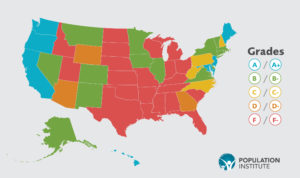
For the first time since the inception of the 50 State Report Card on Reproductive Health and Rights eight years ago, the U.S. as a whole has received a failing grade. The new report card covering 2019 was issued by the Population Institute today, two weeks before the U.S. Supreme Court is scheduled to hear oral arguments in June Medical Services v. Russo, a Louisiana case that could result in further erosion of Roe v. Wade and abortion rights.

The Population Institute’s report card is the most comprehensive of its kind, tracking multiple indicators of reproductive health and rights, including access to family planning, sex education, and abortion services. Over the past eight years the report card has documented a steady erosion of reproductive rights at both federal and state levels.

Among the many setbacks at the federal level over the past year was the new set of rules finalized for Title X, the 50-year old federal program that supports family planning clinics serving low-income households. Commonly known as the “domestic gag rule,” the new rules prohibit Title X-funded physicians and staff from counseling patients on abortion or referring them to abortion providers, among other restrictions. This change forced Planned Parenthood and other trusted family planning and reproductive health providers to drop out of the program, slashing the Title X network’s capacity in half. At the same time, the Trump administration is awarding Title X grants to “crisis pregnancy centers” run by staunch anti-abortion advocates, some of which do not even offer contraceptive services to clients.

The Trump administration is also seeking to cut federal support for comprehensive, evidence-based sex education curricula that are proven to reduce teen pregnancy rates. In their place, the administration is promoting “sexual risk avoidance” programs that embrace an “abstinence-only” approach, which evidence shows fail to reduce teen pregnancy.

In addition to moving the Supreme Court to the right with the appointments of Brett Kavanaugh and Neil Gorsuch, the U.S. Senate has confirmed dozens of Trump-nominated judges to lower federal courts, raising concerns that the federal courts will further curb abortion rights and access to reproductive health care services.  A more conservative federal judiciary is also likely to issue rulings adversely affecting Title X, as well as contraception coverage and LGBTQ protections under the Affordable Care Act.

At the state level, the divide between states that promote reproductive health and rights and those that restrict them continues to deepen.

20 states received a failing grade. They include Alabama, Arkansas, Florida, Idaho, Indiana, Kansas, Kentucky, Louisiana, Michigan, Mississippi, Missouri, Nebraska, North Dakota, Ohio, Oklahoma, South Carolina, South Dakota, Tennessee, Texas, Utah, and Wisconsin.  Several of them passed abortion restrictions that defy the Roe v. Wade guidelines in hopes of persuading the U.S. Supreme Court to overturn the landmark ruling.

Meanwhile, seven states received an “A” in this year’s report card, including California, Hawaii, Maine, Maryland, New Jersey, Oregon, and Washington.

“The political war over reproductive health rights is far from over, but the legal and regulatory battle lines have been drawn, and the stakes could not be higher, said Robert Walker, president of the Population Institute.  “If the opponents of reproductive health and rights have their way,  abortion, contraception, other reproductive health services, and even basic health care, will be pushed even further out of reach for low income individuals.”

“It is imperative we remember those who are most impacted when we fail to provide access to safe and affordable reproductive health care for all,” said Jennie Wetter,  the Population Institute’s director of public policy. “Many people of color and low-income individuals are already struggling to access reproductive health care services. This report card is a call to action for all those who care about reproductive health and rights.”
Methodology

The Population Institute report card ranks each of the 50 states and the District of Columbia according to key criteria as follows:

  • Thirty percent of the grade is based on measures of effectiveness. This includes the latest available data on the teenage pregnancy rate (15%) and the rate of unintended pregnancies (15%).
  • Twenty-five percent of the grade is based upon prevention. This includes mandated comprehensive sex education in the schools (15%), nurses authorized to dispense medications (5%), and minors’ access to contraceptive services (5%).
  • Twenty-five percent of the grade is based upon This includes if states are expanding Medicaid under the Affordable Care Act (15%), Medicaid eligibility rules for family planning (5%), and restrictions of insurance coverage of abortion (5%).
  • 20 percent of the grade is based upon clinic access. This includes abortion restrictions (10%), TRAP Laws (5%), and percent of women living in a county without an abortion provider (5%).

Based on their scores, each state receives a “core” grade (A, B, C, D or F), but some states received an additional “plus” or a “minus” for factors not reflected in the core grade.

Special thanks to the Guttmacher Institute whose research made the report card possible.

Congress Shortchanges Funding for International Family Planning

In a major reversal, Congress this week rejected an increase in U.S. funding for international family planning and reproductive health (FP/RH) programs. The Senate and the House of Representatives passed an appropriations package that freezes spending for those programs at current levels ($607.5 million) for the tenth year in a row.

Earlier this year the House Appropriations Committees approved a $198 million in increase in total funding, while the Senate Appropriations Committee approved an increase of $58 million. But in a stunning capitulation to the Trump administration and family planning opponents, House-Senate negotiators agreed to block any increase in FP/RH programs.  The budget negotiators agreed to significant increases in other foreign assistance categories, including global health, but not family planning.

The final budget agreement approved this week also rejected House-passed language repealing the Trump administration’s “global gag rule (GGR). The GGR originally promulgated by President Ronald Reagan in 1984–and adopted by subsequent Republican administrations—prohibited USAID from funding non-US organizations providing family planning services overseas from advocating for abortion or referring patients to abortion services. The Trump administration has vastly expanded the GGR’s reach by applying the funding prohibition to overseas providers of global health services, not just family planning services. By refusing to fund foreign organizations that advocate for abortion, the GGR forces foreign NGOs to reject US funding and that leads, in turn, to the closure of health clinics and the curtailment of medical services in developing nations.

In reacting to the news, Robert Walker, president of the Population Institute, said, “The rejection of any increase in international funding for FP/RH and the continuation of the GGR may be a victory for the Trump administration, but it is a defeat for the health and wellbeing of women and their families. They have been thrown under the “mini-bus.”

Population Institute Observes 50th Anniversary

In observing its 50th anniversary this year, the Population Institute is celebrating the progress made in advancing sexual and reproductive health and rights.

Now, just as in 1969, reproductive freedom is the cornerstone of a better tomorrow. The right and capacity of people to choose free from coercion whether and when to have children, is a revolutionary development that has improved lives all around the world. Much of the progress we have made in the past half century would not have been possible without the advances we have made in reproductive health and rights.

Those advances have drastically reduced maternal and child mortality, elevated the status of women, allowed girls to complete their education, and enabled women to compete in the workforce. They have boosted household incomes and helped to combat poverty and hunger in some of the poorest countries in the world. They have also eased the pressure on water, land, and other resources, and in a world increasingly threatened by record high temperatures, rising seas, severe drought, and catastrophic flooding, reproductive freedom makes families and communities more resilient in times of crisis.

Reproductive freedom, however, is in peril. At home and abroad, many of the advances made in sexual and reproductive health and rights are under assault, and unless those attacks are rebuffed, the world will be much the worse for it.

In many developing countries, gender inequality is one of the biggest remaining barriers to the realization of reproductive freedom.  Harmful social norms and practices, such as child marriage and sexual violence, restrict reproductive freedom and limit the vast human potential of women and girls.

Now, as in 1969, the Population Institute is committed to educating girls, empowering women, and improving access to reproductive health care for all. Reproductive freedom is not just a basic human right; it is a global imperative.

Our thanks go out to all those who have contributed to the success of the Population Institute and the fulfillment of its mission and vision.

Population Institute Joins The Thriving Together Campaign

Today, the Population Institute joins more than 150 other leading environmental and reproductive health organizations to pledge support for a first-of-its-kind campaign: Thriving Together. The campaign was organized by the Margaret Pyke Trust, located in the United Kingdom, but it has attracted global support. Supporting organizations are united in the belief that removing barriers to the use of family planning services contributes to the health and well-being of women and their families, while also benefiting the environment and biodiversity.

The Population Institute believes that in environmentally sensitive areas, particularly those threatened by resource depletion, holistic approaches—including Population, Health, and Environment (PHE) projects—that improve access to health and family planning services, while also taking steps to restore the environment and protect critical bio-habitats, can make communities healthier, more sustainable and, in the long run, more prosperous.

Two months ago, the Intergovernmental Science-Policy Platform on Biodiversity and Ecosystem Services (IPBES) issued a landmark report warning that human pressures—both population and consumption—are contributing to the unravelling of nature. In releasing the report, IPBES Chair, Sir Robert Watson said, “The health of ecosystems on which we and all other species depend is deteriorating more rapidly than ever. We are eroding the very foundations of our economies, livelihoods, food security, health and quality of life worldwide.”

The UN’s latest population projections indicate that global population will likely rise from 7.7 billion today to 9.7 billion by 2050. Future population growth is uncertain, however, and is highly sensitive to small changes in fertility. If the physical, financial, educational, social and religious barriers to people using family planning services were removed, fertility rates would fall faster than currently projected.

Robert Engelman, a Senior Fellow at the Population Institute, noted that, “Gender inequality is a major contributor to high fertility rates in many parts of the world today. In addition to improving access and removing barriers to the use of family planning information and services, we urgently need to boost the education of girls, eliminate child marriage, and empower women. If we can make progress on those fronts, while also taking action on climate change and boosting support for conservation programs, there’s reason to hope we can create healthier families and a healthier planet.”

WORLD POPULATION DAY: TIME FOR A RENEWED COMMITMENT TO FAMILY PLANNING AND REPRODUCTIVE RIGHTS

Thirty years ago tomorrow, the UN designated July 11th as World Population Day. Today, as then, the world needs to recognize that access to family planning services is a basic human right. Women, regardless of where they live, should be able to determine freely the number and spacing of their children.

The goal of universal access to reproductive health services, however, is still an unrealized aspiration.  More than 200 million women in the developing world today want to avoid a pregnancy, but are not using a modern method of contraception. In addition to improving access to modern contraception, far more needs to be done towards removing the cultural and informational barriers that prevent these women from accessing modern methods of contraception. And those barriers are formidable.

Child marriage practices and the harmful social norms that disempower women and girls in developing countries need to change. Girls must be encouraged and allowed to complete their schooling, and girls and women, everywhere, need better information about contraceptive options.

Tragically, however, the Trump Administration continues to wage what amounts to a war on birth control. In its first year in office, the Trump Administration suspended U.S. support for the United Nations Population Fund (UNFPA), a major provider of family planning services in the developing world. It also re-imposed and vastly expanded the “global gag rule” that cuts off U.S. funding to overseas providers of family planning services—or other healthcare providers—if they advocate for, or refer patients to, abortion services. The Trump administration has been pushing for steep cuts in America’s bilateral support for family planning services in developing countries, while also working actively to undermine Title X, the federal program that supports family planning clinics serving low-income women in the U.S.

The reasons for supporting family planning are, of course, as compelling as ever. Access to birth control empowers women and reduces child and maternal mortality. In developing countries, access to family planning services is an essential ally in the fights to eliminate severe poverty and hunger. And globally, family planning helps to reduce humanity’s environmental footprint, while also relieving pressure on water and other scarce resources. Last year 15,000 scientists signed a proclamation warning that the runaway consumption of limited resources, fueled by rising incomes and a still expanding world population, is crippling the Earth’s life-support systems and jeopardizing life on earth. That warning must be heeded.

In observing World Population Day, Robert Walker, president of the Population Institute, stressed that “America should be leading the fight, not sounding the retreat on sexual and reproductive health and rights. Access to family planning and reproductive health services is a basic human right and the achievement of universal access would be enormously beneficial to women, their families, their communities, and the world at large.”

Population Institute Mourns Loss of Dr. Rena Joyce Weller Karefa-Smart

The Population Institute mourns the loss of the Rev. Dr. Rena Joyce Weller Karefa-Smart, who was the first black woman to graduate from Yale Divinity School and a leader in the international ecumenical movement.  She died on Jan. 9 at her daughter’s home in Rancho Mirage, California. She was 97.

Karefa-Smart was also the first black woman to earn a doctor of theology degree from Harvard Divinity School, in 1976. She was the first female professor of color to receive tenure at Howard University School of Divinity, in 1979. She was ordained as an Episcopal priest and as a minister in the AME Zion Church. She attended the first Assembly of the World Council of Churches and was an ecumenical officer for the Episcopal Diocese of Washington, D.C., and an associate of the Center for Theology and Public Policy there.

Dr. Karefa-Smart’s husband, Dr. John Albert Musselman Karefa-Smart, was a medical doctor and served as Sierra Leone’s first foreign minister. The couple, who were active with the Population Institute, lived for many years in Africa and Europe.  While living in Sierra Leone, Karefa-Smart was a leading supporter of women’s empowerment and family planning. Her husband, who died in 2010, was actively involved with a number of UN agencies, including the United Nations Population Fund (UNFPA).

The New York Times has posted her obituary.