Threats to Reproductive Rights Loom on the 46th Anniversary of Roe v. Wade

Population Institute’s Report Card for 2018 Shows 19 States Getting Failing Grades Amid Continued Attacks on Reproductive Health and Rights
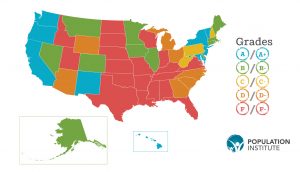
WASHINGTON, D.C. – On the 46th anniversary of the Roe v. Wade decision the Population Institute is releasing its seventh annual 50-State Report Card on Reproductive Health and Rights. The grade for the U.S. as a whole remains at a “D-“ in this year’s report card, but reproductive rights are coming under intensified assault. In particular, the appointment of Brett Kavanaugh to the U.S. Supreme Court could have an adverse impact on future court decisions regarding access to family planning and abortion services. At the state level, 26 states received a “D” or lower, with 19 states receiving a failing grade. The report card, the most comprehensive of its kind, tracks multiple indicators of reproductive health and rights, including access to family planning and abortion services.

The Institute’s president, Robert Walker, said, “On this year’s anniversary of Roe, more than any in the last 46 years, supporters of reproductive rights need to be concerned about the erosion of their constitutionally protected rights. Roe is still the law of the land, but many states are restricting access to abortion services. Last year we said that the U.S. was in danger of becoming ‘The Divided States of Reproductive Health and Rights’ and that danger persists. A woman’s ability to access affordable reproductive health care increasingly depends on where she lives, and if Roe is overturned, or its protections curbed, the legal divide will be even sharper. And, if so, many more women will be effectively denied access to abortion services, and maternity mortality rates will rise as a consequence.”

The National Grade

The U.S., as a whole, received a “D-“. While federal law and federal funding levels remain largely unchanged, new threats emerged in 2018:

·         Title X– In a move that jeopardizes the future status of family planning clinics receiving Title X funding, the Trump administration last year drafted a proposed rule that would deny funding to family planning clinics that provide clients with information about the availability of abortion services. The so-called “domestic gag rule” could cut off funding to many of the existing providers, including—but not limited to—Planned Parenthood.

·         The ACA’s Contraceptive ‘Mandate” – The Trump Administration finalized regulatory changes to the Affordable Care Act, which would allow employers with “religious” or “moral” objections to drop coverage of contraception in the health insurance policies provided to their employees. Two federal courts have put a stay on the proposed changes to the birth control mandate, but the U.S. Supreme Court has yet to weigh in.

·         Conservative Court Appointments – In addition to the appointment of Brett Kavanaugh to the U.S. Supreme Court, the U.S. Senate has confirmed dozens of Trump-nominated judges to the lower federal courts, raising concerns that the federal judiciary will curb access to reproductive health care in the U.S.

State Grades

Ten states (California, Washington, D.C., Hawaii, Maryland, New Jersey, New Mexico, New York, Oregon, Vermont, and Washington) received an “A” in this year’s report. The 19 states receiving a failing grade in 2018 included Alabama, Arkansas, Florida, Idaho, Indiana, Kansas, Kentucky, Louisiana, Mississippi, Missouri, Nebraska, North Dakota, Oklahoma, South Dakota, Tennessee, Texas, Utah, Virginia, and Wisconsin.

Understanding the Results

In releasing this year’s 50-State report card, Walker noted that “This year’s report card reflects the fact that reproductive health and rights remain under critical assault at the state and federal levels. While reproductive health advocates scored significant victories in the 2018 elections, the war on reproductive rights is far from over. Over the last eight years 424 abortion restrictions have been passed at the state level.”

The Guttmacher Institute recently reported that in 2018—for the first time in recent years—new policies protecting reproductive rights outnumbered new restrictions. Walker cautioned, however, “No one should be complacent. Anyone concerned about the state of reproductive health and rights in the U.S. should be paying close attention to what is happening at the national, state and local levels. This fight is far from over, and the worst may be yet to come.”

Methodology

Using eleven criteria, the Institute’s report card ranked each of the 50 states and the District of Columbia:

·       Thirty percent of the grade is based on measures of effectiveness. This includes the latest available data on the teenage pregnancy rate (15%) and the rate of unintended pregnancies (15%).

·       Twenty-five percent of the grade is based upon prevention. This includes mandated comprehensive sex education in the schools (15%), access to emergency contraception (5%), and minors’ access to contraceptive services (5%).

·       Twenty-five percent of the grade is based upon affordability. This includes if states are expanding Medicaid under the Affordable Care Act (15%), Medicaid eligibility rules for family planning (5%), and restrictions of insurance coverage of abortion (5%).

·       The final 20 percent of the grade is based upon clinic access. This includes abortion restrictions (10%), TRAP Laws (5%), and percent of women living in a county without an abortion provider (5%).

Based upon their scores, each state received a “core” grade (A, B, C, D or F), but some states received an additional “plus” or a “minus” for factors not reflected in the core grade.

#   #   #

For a copy of the report, including a state-by-state breakdown, visit the Population Institute’s website (www.populationinstitute.org/reportcard).  For questions about the report, call Jennie Wetter, Director of Public Policy, at (202) 544-3300, ext. 108.

A special thanks to the Guttmacher Institute whose research made this report card possible.
Statement on Proposed Domestic Gag Rule

Last night the Trump-Pence administration unveiled their latest attack on women health and rights, a ‘domestic gag rule’ that will prevent people from getting the health care they need. This proposed domestic gag rule will apply to health care providers seeking Title X grants. Title X is the federal program that supports family planning clinics serving low-income communities in the U.S. The proposed domestic gag rule prevents anyone who receives Title X funding from referring their patients for safe, legal abortion services.

The proposed rule removes the guarantee that patients get full and accurate medical information from their doctors. The rule would allow participating health care providers to withhold any information about abortion services—including potentially life-saving information—from the patient.  Under the new rule, participating health care providers would no longer be required to inform patients of all medically approved methods of birth control. Last, the proposed rule blocks the awarding of Title X funding to any provider, including Planned Parenthood, that provides abortion services through an affiliate office.

Robert Walker, President, Population Institute, commented on the proposed domestic gag rule:

In many communities, denying funding to Planned Parenthood and other highly qualified Title X health care providers could have a severe impact on women’s health care. Low-income women desiring the health care services supported by Title X should be able to get those services from a provider they trust. Slamming the door on Planned Parenthood may please social conservatives who oppose abortion and contraceptive services, but it does not help the people being served by Title X.  It is, in fact, a subversion of the very reason the law was created in the first place. Title X was designed to improve access to health care services, not to restrict it.

Shutting Planned Parenthood and other qualified health care providers out of the Title X program will limit access to a wide range of health care services, including cancer screenings, STI testing and treatment, and well-woman exams. At present, 4 out of 10 Title X patients receive health care services from a clinic run by Planned Parenthood. If this rule is adopted, many will have nowhere else to turn.

America’s teen pregnancy rate has fallen to an historical low and the rate of unintended pregnancy has fallen to a 30-year low. That progress, unfortunately, could be reversed by this new rule. Shame on the Trump administration.

As Amnesty International Calls Out the Trump Administration’s Virulent Attacks on Reproductive Rights of Women and Girls, a New Population Institute Report Card Shows the Impact of Such Attacks on Americans’ Health and Rights

The new Amnesty International report on “The State of The World’s Human Rights” calls out the United States for abridging reproductive rights and harming reproductive health in 2017. The report sharply criticizes the Trump-Pence administration’s “broad and multifaceted” attacks on women and girls, and what it calls “particularly virulent” attacks and “extreme restrictions” on sexual and reproductive health care.  At the same time, Politico reported that State Department officials working on their annual global human rights report were ordered to strike many of its references to reproductive rights, including discussion of abortion rights or access to contraception.

A new study released by the Population Institute, its annual “50-State Report Card on Reproductive Health and Rights” covering 2017, shows that such attacks amount to more than mere words. After the Administration’s first year, the report card finds they have already had a deleterious effect on Americans’ reproductive rights and health. 

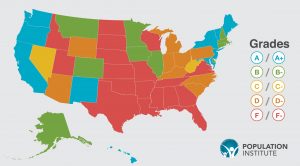
The report card gave the U.S. as a whole a grade of “D-” for 2017. 18 states failed it. It presents evidence that reproductive health and rights are declining nationally, while disparities between states are growing.  The report card findings overall and for each of the 50 states are posted here.

“The Amnesty International report criticizes the Administration for seeking to defund Planned Parenthood, enabling employers to refuse to provide health insurance coverage for contraception, and other attacks on reproductive health and rights,” said Robert Walker, president of the Population Institute.  “The 2017 report card shows that these policies are contributing to an alarming, nationwide decline in reproductive health and rights.”

“Political assaults on reproductive health and rights are demonstrably threatening access to family planning services women want and need,” Walker said.  “In recent years, dozens of family planning clinics have been forced to shut down. There is every reason to believe these attacks on reproductive services will persist in 2018 and beyond. We have a lot of work to do if access to those services is to be preserved.”

Over the past 13 months, the Trump-Pence Administration tried by every means possible to restrict access to family planning and reproductive health services. 

In addition to its campaign to defund Planned Parenthood, the Administration last year proposed to eliminate all funding for international family planning assistance, which was the largest cut to international family planning ever proposed. This year, it proposed cutting it in half, the second largest cut ever proposed.

The Administration is also working to derail the application process for Title X grants, which support family planning clinics serving low-income families. By executive action, the Administration last year cut off funding for the United Nations Population Fund, while also renewing and expanding the “global gag rule,” which seeks to cut off all global health funding for overseas organizations that refuse to sign a pledge indicating that they will not refer patients for abortion services or advocate for abortion rights.

The Divided States of Reproductive Health and Rights

After a Year of Trump Policies, Population Institute’s Report Card on Reproductive Health/Rights for 2017 Lowers Overall U.S. Grade to a “D-”

18 States Get Failing Grade Amid Attacks on Family Planning and Birth Control


On the heels of the Trump administration’s proposed 2019 budget, which seeks to slash support for reproductive health programs, the Population Institute today released its sixth annual report card on reproductive health and rights in the U.S. The results were alarming, showing declining overall reproductive health and rights and growing disparities between states after the first year of Trump policies.  For 2017, the overall U.S. grade fell from a “D” to a “D-.” 18 states got a failing grade.

These findings reflect sharp differences in the way states handle family planning and reproductive health programs, as well as stepped up attacks on those programs by the Trump administration.   “The Trump administration and its allies in Congress have escalated the assault on reproductive health and rights,” said Robert Walker, president of the Population Institute.  “At the state level, we are seeing a deep and growing divide between states that seek to protect reproductive health and rights and those that do not.  States with good grades are gradually improving, while states with poor grades are showing little or no improvement.

The National Grade

The national grade this year fell from a “D” to a “D-“, reflecting escalating attacks on reproductive health and rights at the federal level.

The Trump budget proposal unveiled this week signals worse attacks to come. It would eliminate the Teen Pregnancy Prevention Program, invest in ineffective abstinence-only education programs, and block patients from seeing their preferred health care provider, Planned Parenthood.

Over the past year some Trump administration attacks on reproductive health and rights were blocked, at least temporarily, including a proposed 20-week abortion ban and attempted defunding of Planned Parenthood. But other attacks were carried out.

The Administration diluted the Affordable Care Act’s “contraceptive mandate” by issuing a regulation that enables employers and insurers to delete coverage of contraceptives in their insurance policies, for any religious or moral reason, without even notifying the government. Last year, with Trump administration backing, Congress blocked implementation of an Obama-era regulation prohibiting states, under Title X, from defunding Planned Parenthood and other abortion providers. This year, the Trump administration is seeking to help states terminate Planned Parenthood as a healthcare provider for Medicaid beneficiaries.

Reproductive rights also suffered a judicial setback in 2017 with the confirmation of President Trump’s nomination of Neil Gorsuch to the U.S. Supreme Court and the nomination and confirmation of several district and appellate court justices to the federal bench.

State Grades

First, the good news: Twenty-two states received a B- or higher in 2017. Eleven states (California, Washington D.C., Hawaii, Maine, Maryland, New Jersey, New Mexico, New York, Oregon, Vermont, and Washington) received an “A” in 2017, up from five the year before. The improved showing was largely attributable to state declines in the rate of teenage pregnancy.

But the bad news highlights growing national disparity:  27 states received a “D” or lower. 18 of those states received a failing grade (“F”), including Alabama, Arkansas, Florida, Georgia, Idaho, Kansas, Louisiana, Mississippi, Missouri, Nebraska, North Dakota, Oklahoma, South Dakota, Tennessee, Texas, Utah, Virginia, and Wisconsin.

Understanding the Results

“A woman’s reproductive health and rights should not depend on what state or county she lives in, but increasingly, it does,” said Walker. “This report card shows the disparities are large and growing, as access to abortion services is getting curtailed in many states.” In 26 states today more than 50 percent of the women live in a county without an abortion provider. “The proposed Trump budget would only exacerbate this divide,” he said.

“There is some good news in the midst of all this,” said Walker. “America’s unintended pregnancy rate is the lowest it has been in 30 years and we have reached an historic low in the teen pregnancy rate. But that progress cannot be taken for granted, as the Trump administration made clear with their recent budget. If birth control opponents are ultimately successful in defunding Title X family planning clinics and evidence-based sex education programs, we should expect an increase in both teen and unintended pregnancies.”

“The United States is in danger of becoming, in effect, the Divided States of Reproductive Health and Rights,” said Walker. “We cannot let that happen. All those who are concerned about the state of reproductive health in America should be making their voices heard.”

Methodology

Using eleven criteria, the Institute’s report card ranked each of the 50 states and the District of Columbia:

·       Thirty percent of the grade is based on measures of effectiveness. This includes the latest available data on the teenage pregnancy rate (15%) and the rate of unintended pregnancies (15%).

·       Twenty-five percent of the grade is based upon prevention. This includes mandated comprehensive sex education in the schools (15%), access to emergency contraception (5%), and minors’ access to contraceptive services (5%).

·       Twenty-five percent of the grade is based upon affordability. This includes if states are expanding Medicaid under the Affordable Care Act (15%), Medicaid eligibility rules for family planning (5%), and restrictions of insurance coverage of abortion (5%).

·       The final 20 percent of the grade is based upon clinic access. This includes abortion restrictions (10%), TRAP Laws (5%), and percent of women living in a county without an abortion provider (5%).

Based upon their scores, each state received a “core” grade (A, B, C, D or F), but some states received an additional “plus” or a “minus” for factors not reflected in the core grade.

#   #   #

For a copy of the report, including a state-by-state breakdown, visit the Population Institute’s website (www.populationinstitute.org/reportcard).  For questions about the report, call Jennie Wetter, Director of Public Policy, at (202) 544-3300, ext. 108.

A special thanks to the Guttmacher Institute whose research made this report card possible.

IN MEMORIAM: David Poindexter

The Population Institute mourns the loss of David Poindexter. A former colleague, David championed the use of radio and television serial dramas to promote family planning, gender equity, and protection of the environment. He died February 8 at a hospital in Portland, Oregon, after suffering a stroke. He was 89.

David was Director of the Communication Center at the Population Institute from 1970 to 1985.  In that capacity, and in his later work, he promoted the use of radio and television entertainment programs to promote gender equality and use of family planning, employing a methodology originally designed by Miguel Sabido in Mexico during the 1970s.  Sabido, who was Vice President of Televisa oversaw the creation of a series of telenovelas, serial dramas, which were credited for boosting public acceptance of family planning in Mexico.  David was successful in introducing Sabido and his methodology to India, as as well as, other parts of Latin America.

At the Population Institute, and later as founder and President of Population Communications International (1985-1998), David was instrumental in the creation of social content serial dramas in numerous countries, including Brazil, China, Kenya, Madagascar, Namibia, Nigeria, Pakistan, the Philippines, St. Lucia, and Tanzania.  
Poindexter served as Honorary Chair of Population Media Center, where he helped establish new programs in Ethiopia and Nigeria. He continued in this role until his death, during which time Population Media Center implemented social change serial dramas in 54 countries.

David also chaired the U.S. NGO Committee for the UN Population Conference in 1974, held in Bucharest, Romania. He also served as Convener of the NGO Planning Committee for the 1984 Population Conference, held in Mexico City and as Convener of the NGO Planning Committee for the 1994 UN Conference on Population and Development, held in Cairo. The 1994 NGO Forum became the largest NGO forum in UN history.

Obituary

David Poindexter
(1929-2018)

David Oldham Poindexter, a Methodist minister who championed the use of radio and television serial dramas to promote family planning, gender equity, and protection of the environment, died February 8 at a hospital in Portland, Oregon. He died from the effects of a stroke. Poindexter, who also organized several non-governmental organization (NGO) forums at major UN conferences, was born in Hood River, Oregon in 1929.

After receiving a Bachelor’s of Art at Willamette University in 1951 and both Bachelor’s and Master’s degrees in Theology at Boston University (where he became friends with Dr. Martin Luther King, Jr.), David served as pastor of Parkrose Heights Methodist Church in Portland for eight years. He then moved to New York City to work with the National Council of Churches for five years as Director of Utilization of the NCC’s Broadcasting and Film Commission and then Director of Promotion Services, during which he established close ties with the Hollywood community.

At the request of his bishop, David became Director of the Communication Center of the Population Institute from 1970 to 1985. In the early1970s, he collaborated with John D. Rockefeller III to hold a meeting of the three network CEOs – a meeting also attended by then UN ambassador George H.W. Bush and Senator Robert Packwood – to discuss treatment of gender, reproductive health and family planning issues in television. He convinced the CEOs of the three major networks to host a large gathering in New York of key network entertainment producers and writers. Following that event, he organized annual awards ceremonies in collaboration with the National Academy of Television Arts and Sciences to recognize the best entertainment shows addressing those issues.

One of the outgrowths of Poindexter’s outreach to Hollywood leaders was a long-standing relationship with Norman Lear and his head of drama, Virginia Carter. At Poindexter’s suggestion, the character Maude, in the series by the same name, had a mid-life abortion – six months before the Roe vs. Wade decision by the U.S. Supreme Court. As Norman Lear later put it, “David got Maude pregnant.” Similarly, he suggested the vasectomy of Rob Reiner’s character, Michael, on All in the Family. During his work in Hollywood, Poindexter worked closely with Mary Tyler Moore, who was a great supporter of his work, which helped to bring about the discussion of sexism in the workplace on the Mary Tyler Moore Show.

In the mid-1970s, Poindexter began working in Mexico, where he discovered and promoted the work of Miguel Sabido, a well-known Mexican playwright and television producer who became a pioneer in entertainment-education. As Vice President of Televisa, Sabido produced six telenovelas in the late 1970s and early 1980s, modeling family planning use for Mexican audiences. During that time, Mexico experienced the most rapid decline in fertility rate of any developing country in the 20th century up until that time. These programs had similar effects when they were broadcast in several in Spanish-speaking countries in Latin America. Thomas Donnelly, then with USAID in Mexico, wrote, “The Televisa family planning soap operas have made the single most powerful contribution to the Mexican population success story.”

In the early 1980s, Poindexter took Sabido to meet with Indian Prime Minister Indira Gandhi, and following a training program they organized for Doordarshan (Indian Television), the country began broadcasting India’s first social content soap opera, Hum Log (“We People”) in July 1984. The program included promotion of family planning and elevation of the status of women through the words and actions of key characters. Research conducted by the Annenberg School for Communication and Journalism of the University of Southern California, found dramatic impacts on audience attitudes about women’s rights and ideal family size. The program spurred over 400,000 people to write letters to the Indian Television Authority.

In 1986, Poindexter, with commercial sponsorship from India’s largest industrial conglomerate, helped to organize a second serial drama, which aired in January 1992. Produced by Roger Pereira, Humraahi (“Come Along With Me”) dealt with child marriage, age of first pregnancy, gender bias in childbearing and child rearing, equal educational opportunity, and the right of women to choose their own husbands. A Rockefeller Foundation-funded study showed that viewers, contrasted with non-viewers, changed significantly in their attitudes regarding the ideal age of marriage and the acceptability of women in the work place.

At the Population Institute, and later as founder and President of Population Communications International (1985-1998), Poindexter worked to bring about similar programs in numerous countries, including Brazil, China, Kenya, Madagascar, Namibia, Nigeria, Pakistan, the Philippines, St. Lucia, and Tanzania.

Following retirement in 1998, Poindexter served as Honorary Chair of Population Media Center, where he helped establish new programs in Ethiopia and Nigeria. He continued in this role until his death, during which time Population Media Center implemented social change serial dramas in 54 countries.

Poindexter chaired the U.S. NGO Committee for the UN Population Conference in 1974, held in Bucharest, Romania. He also served as Convener of the NGO Planning Committee for the 1984 Population Conference, held in Mexico City and as Convener of the NGO Planning Committee for the 1994 UN Conference on Population and Development, held in Cairo. The 1994 NGO Forum became the largest NGO forum in UN history.

For over a decade, he was an officer of the Committee on Sustainable Development of the Conference of Non-Governmental Organizations in Consultative Status with the UN’s Economic and Social Division. He also served on the Executive Committee of the Conference of UN Representatives of the Council of Organizations of the United Nations Association-USA (UNA-USA). He was an Honorary Fellow of the Population Reference Bureau, and received the Ninoy Aquino Human Rights Award, an Alumni Citation from Willamette University, the Eleanor Schnurr Award of the UNA-USA, and the Distinguished Service Award of the Population Institute. He was an Honorary Life Board Member of the Council on International Non-Theatrical Events (CINE).

Poindexter’s life and work are captured in his autobiographical book, Out of the Darkness of Centuries, published in 2009.

David is survived by his wife of 65 years, Marian Sayer Poindexter, and his son, Jim.

A memorial service will be held on Tuesday, February 13, at the First United Methodist Church, at 1838 SW Jefferson Street, Portland, Oregon 97201 at 10:30 am.

In lieu of flowers, memorial contributions may be made to Population Media Center, Suite 302, 30 Kimball Avenue, South Burlington, Vermont 05403.

Population Institute Announces 2017 Global Media Award Winners

The Population Institute today announced the winners of its 38th annual Global Media Awards. In a slight departure from previous years, this year’s winners were selected for their research, writing or reporting on topics related to the escalating political assault on reproductive health and rights in the U.S. 

In announcing the awards Robert Walker, the president, noted that, “Last year was an extraordinary year, especially at the federal level, where President Trump and his allies in Congress, sought to target Planned Parenthood, restrict abortion rights, repeal the Affordable Care Act, eliminate funding for family planning, terminate the Teen Pregnancy Prevention (TPP) program, and stack the federal judiciary with judges who are hostile to reproductive rights.” 

Given these unprecedented attacks on reproductive health and rights, Walker said that, “We felt it was important to acknowledge the individuals and organizations that have done the most to keep the public informed on these issues and their public policy implications.”

This year’s awardees are:

Sarah Kliff, a reporter on health policy for Vox, received an award for “Best Reporting for her coverage of issues relating to reproductive health and rights, including a special report (“Leaked regulation: Trump plans to roll back Obamacare birth control mandate”) that she co-authored with Dylan Scott. Other reports of note include her coverage of the record-setting decline in teen births, and the Trump Administration’s attack on the ACA’s birth control mandate.

Jessica Mason Pieklo and Imani Gandy, attorneys who write for Rewire, received the award for “Best Podcast” for their new series titled “Boom! Lawyered.” Their podcasts have provided insightful coverage of the escalating legal fights over reproductive rights, including a podcast that looked at efforts by Operation Save America to undermine enforcement of The Freedom of Access to Clinic Entrances (FACE Act), which was signed into law in 1994 by President Bill Clinton.

Amanda Marcotte received an award for “Best Editorial” for a series of hard-hitting opinion pieces that she wrote on what she characterized as the Trump administration’s “war on birth control.” Marcotte is a writer for Salon who covers American politics, feminism, and culture. Her stories in 2017,included “A new war on birth control: Trump’s victory has empowered the sex scolds”, “War on birth control: Health secretary nominee Tom Price could seriously damage contraception access, even under Obamacare” and “A new front in the assault on women’s freedom: Anti-choice activists now going after birth control”.

The Guttmacher Institute received the award for “Best Research,” for the series of reports they published quantifying the human costs of eliminating or rolling back federal support for family planning and reproductive health programs, including evidence-based teen pregnancy prevention programs. Policymakers and reporters, alike, have come to rely upon the Guttmacher Institute for their analysis of federal and state programs supporting family planning and reproductive health.

The Kaiser Family Foundation (KFF) received the award for “Best News Reporting Service,” for the morning briefings provided by Kaiser Health News (KHN) on issues relating to reproductive health. KFF is also being recognized for its fact sheets on the Trump Administration efforts to rollback reproductive health coverage. 

Planned Parenthood Action Fund received the award for the “Best Social Media Campaign.” The award was given for its #Fight4BirthControl campaign that sought to mobilize public opinion against Trump administration efforts to undermine women’s access to affordable birth control. 

Dorothy Samuels, currently a senior fellow at the Brennan Center for Justice, received the Population Institute’s “Lifetime Achievement” award for her editorial opinions in support of reproductive health and rights. Samuels was a member of the New York Times editorial board for 30 years, and is a widely recognized voice in the fight over reproductive health and rights.

Trump Administration Continues It’s War on Birth Control

Today the Trump administration announced a major roll back of the Affordable Care Act’s no co-pay birth control. The new rule, which goes into effect immediately, allows all employers, schools, and insurers to decide not to cover birth control for any moral or religious reason.

This change will have a major impact on women’s health and women’s ability to access effective and affordable birth control. The Obamacare mandate saved women $1.4 billion in out of pocket costs in the first year on birth control pills alone.

Robert Walker, President, Population Institute, commented on the roll back of birth control coverage:

“The Trump administration has escalated their war on birth control by allowing employers to stop covering birth control for any moral or religious reason. This will put basic health care out of the reach for many women, putting their health at risk. It is an outrageous attack on women’s health care and women’s ability to plan their families.

Earlier this week in releasing a special report, “Senseless: The War on Birth Control,” the Population Institute documented the escalating assault on birth control since 2011, including  attacks on Planned Parenthood, implementation of Trump’s expanded Global Gag Rule, and proposed elimination of funding for Title X and international family planning. This administration and its allies are conducting an all-out assault on women’s access to reproductive health care.”

Senseless: The War on Birth Control

The Population Institute today released “Senseless: The War on Birth Control.” The report offers an eye-opening look at how birth control opponents at the federal and state levels are mobilizing in an effort to restrict access to family planning services and information.

The Trump Administration and its allies in Congress have failed, thus far, to “repeal and replace” the Affordable Care Act, which substantially expanded insurance coverage of contraceptive services. But birth control opponents are attacking on multiple fronts. Numerous policies and programs, including Title X, are at risk of elimination. Created in 1969 with broad bipartisan support, Title X is a federal program that supports family planning clinics serving low-income communities in the U.S. Birth control opponents are even seeking to eliminate evidence-based sexuality education programs in our schools and replace them with failed “abstinence-only” programs. The Trump Administration is also seeking to defund U.S. support for family planning services in developing nations.

Robert Walker, president of the Population Institute, said, “Birth control opponents will stop at nothing in their bid to restrict access to contraceptives services and information. They are making regulatory changes, amending laws, cutting funding, changing longstanding policies, and filing legal challenges. It is a breathtaking assault on reproductive health and rights at home and abroad, and it is not going to end anytime soon.”

In addition to detailing the numerous attacks on birth control funding and policies, the report looks at the shifting—and senseless—rationales being offered up by birth control opponents. Walker said, “The arguments that are being made by birth control opponents lack any rational basis. If women are deprived of access to contraception, the results are predictable. There will be more unwanted pregnancies, more abortions, more maternal deaths, and increased government outlays. Opposition to birth control, measured by any desirable outcome, is just plain senseless.”

Download Full Report

Trump’s First Budget: America First Women Last?

President Trump released his first budget today giving us a better understanding of the Administration’s priorities. Unfortunately, the priorities are terrible for women in the United States and around the world.

Domestically the budget targets programs that disproportionately benefit low-income women such as Medicaid, Supplemental Nutrition Assistance Program (SNAP or food stamps), and Temporary Assistance for Needy Families (welfare). The budget also eliminates funding for the Office of Adolescent Health’s Teen Pregnancy Prevention Program that uses evidence based programs to reduce teen pregnancy and prevent HIV and other STDs.

For the first time ever the President’s budget singles out a single organization—Planned Parenthood—from receiving any federal funding. If enacted the President’s Budget would mean that people on Medicaid would no longer be able to go to Planned Parenthood for providing any health care services, including cancer screenings or contraceptives. Such a step would do little to restrict abortion, but it would deny as many as 2.5 million women access to their preferred health care provider, and, in some cases, any provider. Planned Parenthood would also be banned from receive any funding under Title X.

In a stunning setback for women in the Global South, the Trump budget also eliminates all funding for international family planning. According to the Guttmacher Institute, the $607.5 million the United States invested in international family planning in the current fiscal year, FY2017 will:

·         Enable 26 million couples to received contraceptives services;

·         Prevent 8 million unintended pregnancies.

·         Prevent 3.3 million abortions, most of which would have been unsafe; and

·         Prevent 15,000 maternal deaths

Commenting on the release of the President’s budget, Robert Walker, president of the Population Institute, said:

If enacted this budget would be a devastating setback for women around the world. And it is not the first setback. The Trump Administration has already revived and dramatically expanded the Global Gag Rule, which, under the pretense of stopping abortions, will actually increase the number of abortions performed overseas, not reduce them. Today’s proposed budget, however, opens up a whole new front in the War on Women by seeking to defund international family planning. If approved by Congress, it would deny millions of women in the developing world the ability to space or limit pregnancies.  And that, unfortunately, will translate into more maternal deaths, more unplanned pregnancies, more abortions, and a major setback in the wars on hunger and poverty.

Trump Administration Continues Attacks on Women by Defunding UNFPA

On March 30th the Trump Administration announced that they will be defunding the United Nations Population Fund (UNFPA).  UNFPA works in 150 countries providing a range of sexual and reproductive health services including: family planning, midwife training, prenatal care and safe childbirth, and programs to end child marriage and female genital cutting. The U.S. is the fourth largest donor to UNFPA and the loss of U.S. funding could mean the loss of services to 10.5 million women and girls.

Beyond these services UNFPA is on the frontlines in humanitarian crises and UNFPA’s work in humanitarian settings will be one of the areas hardest hit by the U.S. funding prohibition. Last year with U.S. funding UNFPA reached 9 million people in crisis settings with sexual and reproductive health care.  Losing U.S. funding will put the lives of women and girls around the world at risk.

Robert Walker, President, Population Institute, commented on the Trump Administration’s defunding of UNFPA saying:

“Defunding UNFPA is another attack on women and women’s health by this administration. We are not even 100 days into this administration and so far they have reinstated the Global Gag Rule, allowed states to block abortion providers, including Planned Parenthood, from receiving Title X funding, and now they are defunding UNFPA. This is creating a clear pattern of attacking women’s health and rights, putting women’s lives at risk both at home and abroad. Because make no mistake women’s lives will be at risk due to defunding UNFPA.”