Does Rights-based Family Planning Really Matter to Environmental Sustainability? A Reborn Project and New Director Explore the Evidence at the Population Institute

Striving to improve the well-being of both people and the planet, the Population Institute (PI) is launching a new effort to understand a critical connection: how family planning relates to prospects for environmental sustainability.

Under PI auspices, the FP/Earth project will explore the scientific case that removing barriers to the use of contraception and helping to realize people’s right to reproductive health worldwide can supplement and enhance efforts to slow climate change, ease human pressure on the natural world, and improve food security and health. Directed by Céline Delacroix of the University of Ottawa, the project renames and continues the work of the Family Planning and Environmental Sustainability Assessment (FPESA), sponsored by the Worldwatch Institute from 2013 to 2016.

Over three years, the FPESA project engaged a network of research assessors from around the world to assess peer-reviewed scientific articles relating to the family planning-environment linkage. The project’s 165-page report, published in 2016, concluded that scientists generally considered the size and growth of human population as important factors in climate change and environmental degradation.

But few scientists probed the linkage carefully, much less considered the potential for population growth to slow as a side benefit to improved access to reproductive health services and increased use of family planning. One exception, the project found, was that many researchers based in sub-Saharan Africa called for improved family planning services to contribute to more sustainable and secure food production in their region.

Under the direction of Ms. Delacroix, FP/Earth will build on the work of the FPESA project, continuing the assessment of journal articles. It will also encourage more scientific work on the linkage by developing and keeping informed a network of interested researchers. The reborn project will also engage in advocacy on behalf of rights-based family planning, while working to highlight how reproductive freedom can aid in achieving environmental sustainability.

The basic message relayed by the FP/Earth project is one espoused by many in the broader movement for sexual and reproductive health and rights: Fulfilling reproductive rights by empowering each person to choose the number, timing, and spacing of their offspring has a positive impact on the health and well-being of people.  When people have control over their reproductive health and well-being, this, in turn, can have a positive impact on environmental sustainability. Removing existing barriers to family planning can help fulfil people’s reproductive rights, while also slowing population growth. As scientific findings have demonstrated, slower growth can both help ease human pressure on the climate and environment and facilitate resilience to environmental and climate change already occurring.

“Acknowledging and harnessing these connections has the potential to strengthen reproductive freedom as well as the chances for future generations to live in a sustainable environment,” says Céline Delacroix, FP/Earth Project Director.

The FPESA project engaged the collaboration of 25 researchers from around the world, roughly evenly divided by women and men and representatives of low, middle, and high-income countries. Robert Engelman, former president of the Worldwatch Institute and now a Senior Fellow at the Population Institute, founded and directed the FPESA project and will serve as an adviser to the new phase of the project.

“How the use of family planning influences environmental sustainability is among the most important but rarely asked questions society faces,” Engelman said.  “I’m delighted and grateful to the Population Institute for sponsoring Céline Delacroix to direct this new phase of a project probing and educating on the linkage. Céline’s deep experience and talent will bring the project to a broader community and into a new era, in which it is needed more than ever.”

FP/Earth will pursue its work as a project of the Population Institute under the overall guidance of Kathleen Mogelgaard, who assumed the presidency of the Institute in May.

“The Population Institute seeks to improve the health and well-being of people and the planet by supporting policies and programs that promote sexual and reproductive health and rights,” said Mogelgaard. “We are thrilled to support Céline and the work of FP/Earth in shedding light on the ways in which the realization of rights for people everywhere contributes to sustainability.”

www.fpearth.org

Contact

Céline Delacroix

Director, FP/Earth Project

[email protected]

Biden-Harris Administration Budget Proposal Would Eliminate the Hyde Amendment

Last week, the Biden-Harris administration released their proposed budget for Fiscal Year 2022. The administration took a huge step towards reproductive freedom by removing the Hyde amendment from their budget, the first administration to do so in decades. The Hyde amendment blocks people on Medicaid and those who have federal insurance, such as federal employees and their dependents, and people in federal prison or detention among others, from accessing abortion care. Evidence has clearly demonstrated that the Hyde amendment disproportionately impacts people of color, LGBTQ+ people and immigrants.


The budget also includes funding increases for the Title X program, the federal program that supports family planning clinics serving low-income communities in the U.S, and for international family planning programs, particularly the United Nations Population Fund (UNFPA). Despite these increases, the proposed funding figures are still not adequate to meet the growing need for family planning and reproductive health services in the US and around the world. This is particularly true for international family planning programs, for which funding has declined over the past decade, even as other global health programs have grown.


Speaking about the release of the President’s first budget, Population Institute President and CEO Kathleen Mogelgaard said: “Eliminating the harmful Hyde amendment was long overdue, and we are happy to see that the Biden-Harris administration kept their promise to remove it. But there are additional important steps to take toward the goal of reproductive freedom for people in the US and around the globe, including greater funding to meet growing needs for international family planning and elimination of the Helms amendment, which sets up harmful obstacles to the delivery of vital reproductive health care in communities in low and middle income countries. The fight now moves  to Congress, where we will work alongside our allies to encourage increased investment in sexual and reproductive health and rights at home and abroad.”

The Population Institute Applauds the Reintroduction of the Reproductive Rights are Human Rights Act

The Population Institute applauds the reintroduction of the Reproductive Rights are Human Rights Act today in the House and Senate. The bill, sponsored by Representatives Katherine Clark (MA-05), Gregory Meeks (NY-05), Barbara Lee (CA-13), Lois Frankel (FL-21), Grace Meng (NY-06), Norma Torres (CA-35), and Sara Jacobs (CA-53) in the House of Representatives and by Senators Robert Menendez (D-NJ), Jeanne Shaheen (D-NH), Richard Blumenthal (D-CT) and Cory Booker (D-NJ) in the Senate, would ensure that the State Department reports on reproductive rights in a way that aligns with international human rights standards, and would prevent future administrations from eliminating this crucial reproductive rights reporting.

Under the provisions of the Reproductive Rights are Human Rights Act, the State Department’s annual human rights report would include the status of key reproductive rights issues around the world, such as access to abortion, contraception, and family planning information; access to safe, respectful maternity care; current rates of preventable pregnancy-related deaths and injuries; and information on systemic forms of reproductive coercion, including coerced abortion, involuntary sterilization, coerced pregnancy, and obstetric violence.

Speaking about the reintroduction of the Reproductive Rights are Human Rights Act, Population Institute President and CEO Kathleen Mogelgaard said: “When governments restrict people’s ability to plan their families, they are attacking a fundamental human right. The freedom to choose whether and when to become a parent is a vital component of our economic, social, and political rights. Unacceptably, for the last four years, reproductive rights violations were eliminated from the State Department’s human rights reports. By passing the Reproductive Rights Are Human Rights Act, Congress can ensure that the United States will always shine a light on efforts to take away people’s reproductive freedom around the world.”

The Population Institute Appoints Kathleen Mogelgaard as the New President and CEO

The Population Institute is pleased to announce the appointment of Kathleen Mogelgaard as President and CEO, effective May 3, 2021. She succeeds Robert Walker, who is retiring as President and CEO after working 12 years for the Institute.

For the past three years Kathleen has been a Senior Fellow at the Population Institute and Principal of KAM Consulting, LLC, where she worked with partners in Washington and globally to promote deeper understanding of issues that are critical for sustainable development, including population dynamics, reproductive rights, gender, climate change, and food security. She brings to the Institute a passion for advancing solutions to global challenges that incorporate multiple benefits for human and planetary well-being.

“Kathleen is an innovative thought leader and effective communicator on the importance of population issues and reproductive health and rights,” said Bill Ryerson, Chair of the Population Institute’s Board of Directors. “Her diverse experiences working across sectors will bring immense value to the Institute, and we look forward to the fresh perspectives and direction she will provide, including her expertise on the multiple links between population issues and climate change.”

Previously, Kathleen served as senior advisor for population, gender, and climate change at PAI, policy advisor at Oxfam America, assistant director of government relations at the National Audubon Society, and fellow at the Population Reference Bureau, where she provided research support and technical assistance for conservation and development projects in Africa and Asia. At the World Resources Institute, she participated in negotiations on the UN Framework Convention on Climate Change, where she advocated for accelerated action for effective adaptation planning. More recently, Kathleen was the lead researcher and writer of “Unfinished Business: The Pursuit of Rights and Choices for All,” the United Nations Population Fund’s 2019 State of World Population Report.

“I have long admired the work of the Population Institute in educating stakeholders on the importance of population issues and the centrality of reproductive health and rights, and I’m deeply grateful to have learned from Robert Walker and the Institute’s staff in my time as a fellow,” Kathleen said. “I am thrilled to move into a leadership role at a time when the world is beginning to give greater attention to values of equity, justice, and inclusion – values that are at the core of the Institute’s mission, and areas where the organization can continue its history of valuable education and advocacy.”

Kathleen received a bachelor’s degree in environmental science from the College of William and Mary, and master’s degrees in public policy and natural resources from the University of Michigan. She is on the faculty at the University of Maryland, where she teaches courses in political engagement and advocacy. She resides in Washington, DC with her family.

A Turning Point for Reproductive Health and Rights

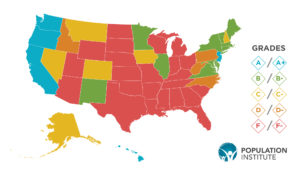
Today the non-profit Population Institute released its ninth annual 50 State Report Card on Reproductive Health and Rights. The most comprehensive assessment of its kind, the report card tracks multiple indicators of reproductive health and rights, including sex education and access to family planning and abortion services across each state. The latest report card finds that there is still a large divide between states that are prioritizing reproductive rights and access to reproductive health services versus those that are seeking to curtail them. Five states got an “A” in this year’s report card, 23 states failed, and for the second year in a row, the U.S. as a whole also failed.

The Biden-Harris administration will strive to improve reproductive health and rights at the federal level, but the reshaping of the federal judiciary by the Trump-Pence administration could undermine Americans’ reproductive health, rights and justice for decades to come. “Because of the conservative shift of the courts,” said Jennie Wetter, the Population Institute’s director of public policy, “the Biden-Harris administration faces a steep uphill battle in its fight to protect reproductive health and rights. With the future of Roe at stake we have reached a critical turning point for reproductive health and rights. The federal courts will become a perpetual battleground.”

Over the past year anti-choice advocates were relentless in their efforts to restrict access to reproductive health care. In several states they used the pandemic as a pretext for denying access to abortion services by classifying it as non-essential health care. Last month, in the waning days of the Trump administration, the U.S. Supreme Court, which now includes three Trump-appointed justices, granted a Trump administration request made last year requiring people seeking a medication abortion to see a doctor in person. This forces patients to make an unnecessary trip to a hospital or a physician’s office in the midst of a pandemic putting their health needlessly at risk.

While the courts have blocked many attacks in recent years, Wetter said, “Anti- choice advocates will keep trying to restrict access to reproductive health services. The Biden-Harris administration has a lot of work to do. Not everything will be easily or quickly fixed. One thing that the Biden administration could immediately address is medication abortion. They could waive the in-person requirement for medication abortion during the pandemic and ask the FDA follow scientific evidence and remove the requirement permanently.”

Taking advantage of the new make-up of the Supreme Court, anti-choice advocates are expected to unleash a flurry of legal challenges to any new legislative or regulatory changes.  “If they succeed,” Wetter warned “the people most impacted will be underserved populations, including low income people, Black people, other communities of color, young people, and the LGBTQ+ community. That means the existing disparities in access to reproductive health services will worsen. Despite the new Congress and the new administration, the fight over affordable access to sexual and reproductive health care is far from over.”

Methodology — Using thirteen separate criteria, the Institute’s report card ranks each of the 50 states and the District of Columbia according to four broad indicators relating to reproductive health and rights: effectiveness, prevention, affordability, and access. Based upon their composite scores (0-100), each state receives a “core” grade (A, B, C, D or F), but some states received an additional “plus” or a “minus” for factors not reflected in the core grade.

State Grades – Five states (California, Hawaii, New Jersey, Oregon, and Washington) received an “A” in this year’s report. Twenty-three states received a failing grade: Alabama, Arizona, Arkansas, Florida, Georgia, Indiana, Kansas, Kentucky, Louisiana, Michigan, Mississippi, Missouri, Nebraska, North Dakota, Ohio, Oklahoma, South Carolina, South Dakota, Tennessee, Texas, Utah, Wisconsin, and Wyoming.

The National Grade – For the second year in a row, the U.S., as a whole, received an “F.” Several factors account for the failing grade, notably:

  • Title X – The Trump-Pence administration’s imposition of a “domestic gag rule,” which bars Title X clinics from counseling patients about abortion or referring them to abortion services. This had a devastating impact on the Title X grant program, which provides family planning services to 4 million households a year. Several states and providers, including Planned Parenthood, opted out rather than abide by the new restrictions. As traditional and trusted family providers dropped out, the Trump administration replaced them by awarding Title X grants to “crisis pregnancy centers” run by staunch anti-abortion advocates, some of whom do not even provide contraceptive services to clients.
  • Federal Courts – After the death of Justice Ruth Bader Ginsburg, President Trump appointed his third justice to the U.S. Supreme Court. With Amy Coney Barrett joining fellow Trump appointees Brett Kavanaugh and Neil Gorsuch on the bench, there is now a solid 6-3 conservative majority. Meanwhile, the U.S. Senate also confirmed over 200 Trump-nominated judges to lower federal courts. In addition to restricting abortion rights, a more conservative federal judiciary could render rulings adversely affecting Title X, the coverage of contraception under the Affordable Care Act, and LGBTQ protections.
  • Sex Education – The Trump-Pence administration sought to slash federal support for evidence-based, comprehensive sexuality education. Instead, the administration is promoted “sexual risk avoidance” programs that embrace the failed “abstinence-only” approach backed by conservatives. Such programs are shown to have negative reproductive health outcomes.

President Biden Issues Executive Order on Reproductive Health and Rights

The Population Institute congratulates the Biden-Harris administration for taking the first steps toward undoing the harmful and restrictive anti-abortion policies of the previous administration.

President Biden today signed an executive order rescinding the global gag rule, which bars foreign NGOs that receive U.S. global health funding from counseling patients about abortion or referring them to abortion services. The order reverses a Trump-era policy that disrupted the provision of health care, including abortion services, to millions of people in developing countries.

The president also directed the U.S. Department of Health and Human Services to begin immediately to review Trump-era regulations that prohibited Title X grantees from counseling or referring patients for abortion services. The restrictions have interfered with the trusted relationship between medical professionals and their patients, forcing many family planning providers including Planned Parenthood affiliates, to drop out of Title X program. The restrictions have jeopardized the very future of a program that has provided family planning services to tens of millions of low-income households.

Robert Walker, president of the Population Institute, hailed the Biden-Harris administration for taking these vital first steps, but warned that much more needs to be done to rectify the damage inflicted by the Trump-Pence administration. “President Trump and his allies waged an unrelenting war on reproductive health and rights that has jeopardized the health and well-being of millions both at home and abroad. It will take time to correct these wrongs and move forward with an ambitious agenda for sexual and reproductive health, rights, and justice, but we must do so with urgency, and Congress, as well as the administration, will need to do its part.”

Soon after taking office in 2017 the Trump-Pence administration suspended U.S. support for the United Nations Population Fund (UNFPA). The executive order renews support for the agency, which is a major provider of family planning and reproductive health care in the Global South. The executive order also repudiates U.S. support for the Geneva Consensus Declaration, a Trump-Pence initiative which sought to undermine international support for both abortion rights and LGBTQ+ rights.

Walker said “Trump-era policies have done incalculable harm to women, young people, and the LGBTQ+ community both in the U.S. and abroad. It’s time to take a fresh new look at America’s approach to sexual and reproductive health, rights and justice, starting with consideration of priorities laid out in the Blueprint for Reproductive Health, Rights, and Justice, a roadmap that was endorsed last year by more than 100 organizations, including passing the Global Health, Rights, and Empowerment (HER) Act, the EACH Woman Act, and the Abortion Is Health Care Everywhere Act.”

The HER Act, which would permanently repeal the global gag rule, was introduced today in the U.S. Senate by Senators Jeanne Shaheen (D-NH), Susan Collins (R-ME) and Lisa Murkowski (R-AK) and more than 40 of their colleagues. The HER Act was introduced today in the House by Rep. Barbara Lee (D-CA), Ami Bera (D-CA), Jan Schakowsky (D-IL) and 170 additional cosponsors.

A Message from Robert Walker, President of the Population Institute

Dear friends and colleagues,

Earlier this year I informed the Population Institute Board of Directors of my desire to step down as president by June 2021. In the interest of ensuring a smooth transition, the Board recently launched a search process for a new president. I am highly confident that the search will be successful in recruiting a replacement that will carry on the critically important work of the organization and expand its impact.

My decision to retire was not an easy one, but having worked non-stop in Washington for more than four decades, including 12 years for the Population Institute, I think it is time for a change. While I hope to remain active in my support of the causes I believe in, including the work of the Population Institute, I look forward to taking on new challenges and pursuits.

This is, I believe, an opportune time for new leadership at the Population Institute, which last year celebrated its 50th anniversary. We live in a world fraught with peril, but also bursting with potential. Despite all the challenges and the setbacks, there is genuine cause for hope. Change is in the air. Progress is still possible, and transformative change is still within reach.

The Population Institute has long envisioned a world where girls and women achieve full gender equality; all women have access to reproductive health services, every child is a wanted child, and where global population is brought into balance with a healthy global environment and resource base. With its highly capable staff and distinguished Board of Directors, I am highly confident that the Population Institute will, under its new leadership, make a significant contribution to the ultimate realization of that vision.

I am immensely proud of what the Population Institute has been able to accomplish during my tenure. I hope that I have contributed in some way to its success, but much of the credit goes to the staff, the Board of Directors, and all the individuals and foundations that have supported our work.

I have thoroughly enjoyed my time at the Population Institute. I’m deeply grateful for the opportunity to serve, and I look forward to my remaining few months on the job.

Sincerely,

Robert Walker
President

The Population Institute has retained Korn Ferry to assist in the recruitment of a new president. Anyone interested in being considered for the position should apply here.

Confirmation of Amy Coney Barrett Jeopardizes Reproductive Rights, LGBTQ Rights, and Access to Healthcare

Yesterday the Senate confirmed president Trump’s appointment of Amy Coney Barrett to the U.S. Supreme Court, shifting the balance of the Court even further to the right and putting at risk our health and rights for years—perhaps decades—to come.

At a time when the Senate should have been passing a Covid relief bill, Mitch McConnell was more interested pushing through a nominee who threatens Americans access to health care. This process was unprecedented as more than 60 million people have already voted in the 2020 election and voting ends in 7 days. Instead of giving the American people a say in the future of the court, Senate Republicans rushed through Amy Coney Barrett.

Barrett replaces Ruth Bader Ginsburg, a fierce defender of women’s rights and reproductive rights. Justice Barrett’s record show she’s no Ruth Bader Ginsburg. Her appointment to the Supreme Court could have a tremendously adverse impact on abortion rights, birth control access, LGBTQ rights, civil rights, voting rights, the Affordable Care Act and so much more. While this is an enormous setback for reproductive rights and justice, there will be many more fights to come. As advocates of equality, justice, and reproductive freedom for all, we must renew our commitment and resolve. The struggle is far from over.

Population Institute Statement on the Death of Justice Ruth Bader Ginsburg

We are heartbroken by the loss of Justice Ruth Bader Ginsburg. Over her long career she has left an indelible legacy of making this country fairer and more equal for all.

Justice Ginsburg fought for gender equality, civil rights, LGBTQ rights, and for reproductive rights. She wrote powerful opinions, perhaps none more so then those that began with “I dissent”.

She was a powerful advocate for justice and will be deeply missed on and off the Court. She may be replaced on the Supreme Court, but she will not be replaced in our hearts. Her tireless advocacy on behalf of women has inspired millions, giving birth to a whole new generation of advocates, who will carry on her fight for equality and justice. We must preserve her legacy by continuing to fight for equal and reproductive rights for all.

THE POPULATION INSTITUTE CONDEMNS REPORTS OF FORCED STERILIZATIONS OCCURRING AT AN ICE DETENTION CENTER

The reports of forced sterilizations occurring in Immigration and Customs Enforcement (ICE) detention facilities are extremely alarming. This is an egregious and staggering violation of human rights. No one should be subjected to reproductive coercion in any form. Unfortunately, the U.S. has a shameful history of forcing Black, Indigenous, and other People of Color (BIPOC), along with people with disabilities, to undergo sterilization.

Reproductive rights are human rights. The right to conceive a child is a fundamental right and it is a universal right. Eugenics, forced sterilizations, and other violations of childbearing rights have no place in a civilized society, and that applies with special urgency to the oppression of BIPOC women and women with disabilities.

Over the past four years, the Trump administration has demonstrated a callous disregard for the human rights of immigrants and refugees. This must stop. Our nation should be committed to the highest standards of human rights for all, including immigrants and refugees. All too often in our history our nation has fallen far short on human rights, including reproductive rights, and we must be vigilant in defense of those rights.