Expanded Global Gag Rule Is Latest Assault

Last Friday, Vice President J.D. Vance announced the Trump administration’s sweeping expansion of the global gag rule. Although advocates were bracing for it, the new rule emphasizes the administration’s intensifying strikes on sexual and reproductive rights worldwide.

The global gag rule has been employed by every Republican president since Ronald Reagan and rescinded by every Democratic president since. The rule mandates that foreign nongovernmental organizations cannot provide, counsel on, refer for, or offer information on abortion care as a method of family planning, even in countries where abortion is legal, even with their own non-U.S. funds. If they do, they cannot receive U.S. family planning assistance.  

The Trump administration already expanded the global gag rule when it took office in 2017 and again in 2025, to cover all U.S. global health assistance, increasing the amount of affected funding from around $600 million to $12 billion. 

The latest expansion extends abortion restrictions more broadly than ever before—to include all foreign aid, including humanitarian programs run by U.S. organizations, UN partners, and other governments, and programs that promote gender equality, and diversity, equity, and inclusion (DEI).  

The harm to women and families continues. The Population Institute joins our colleagues and partners in condemning this damaging policy. With the 2025 dismantling of USAID, once a global leader in family planning and reproductive health, so much progress has been lost for women and girls worldwide. One year ago was the beginning of the avalanche that reversed decades of progress, leaving an estimated 130,000 women in low- and middle-income countries without access to contraceptive services every day; over one year 47.6 million women and couples will be denied modern contraception, according to the Guttmacher Institute. The consequences are profound with an estimated 17.1 million unintended pregnancies and about 34,000 preventable pregnancy-related deaths. 

Congress must act now to pass the Global Health, Empowerment, and Rights (HER) Act, legislation that would permanently repeal the global gag rule, and stop the seesaw of damage to women’s lives.


Population Institute Welcomes New Board Members

Last month, Population Institute’s Board of Directors approved four new members. These new members reinforce the Board’s collective capacity to steward the organizational mission—to improve the health and well-being of people and the planet by supporting policies and programs that promote sexual and reproductive health and rights. New members are movers and shakers that represent a diverse group bringing experience in finance, advocacy, communications, and policy. We are excited for them to join our team!


Jill Chanley is a global health communications and advocacy leader who drives evidence-based strategies that advance public health policy worldwide. In her current role as associate director of communications at the Global Health Advocacy Incubator, she leads strategic communications, media, and digital advocacy efforts in partnership with civil society organizations advancing food and nutrition policies across Africa and Asia. This experience, coupled with her deep knowledge of sexual and reproductive health, gender equality, and public health systems, will strengthen PI’s ability to shape policy discourse, elevate global storytelling, and advance equity and rights for women and girls worldwide.


Zoe Costomiris is a partnerships specialist at UNFPA, the United Nations sexual and reproductive health agency, where she supports resource mobilization, innovation, and advocacy efforts for women and girls across humanitarian and development contexts. Zoe has experience engaging public and private sector partners to fund sexual and reproductive health and gender-based violence programs globally and a background in research and public health that will strengthen PI’s capacity to build strategic alliances, expand global impact, and advance equitable access to reproductive health services.


Asha Dahya is an Emmy-nominated producer, writer, TEDx speaker, and storyteller. Her stories cover sensitive and timely topics such as immigration, abortion, and reproductive choice. She is the founder of the daily feminist blog site GirlTalkHQ.com. Asha brings to the Board a rare combination of media strategy, reproductive rights advocacy, and global storytelling expertise. Her skills will enhance the PI’s visibility, expand its narrative impact, and strengthen its communication and advocacy efforts across diverse audiences.


Martha Durdin is a senior executive and board leader whose career spans corporate, cooperative, and nonprofit sectors. She has built a record at the intersection of governance, finance, public policy, and organizational transformation, and is known for disciplined board stewardship, strategic clarity, and an ability to steady organizations during complex transitions. Professionally, among other corporate leadership roles, Martha served as president and CEO of the Canadian Credit Union Association, where she modernized governance systems, strengthened member value, and led national advocacy to update legislation in recognition of credit unions. Martha brings to the Board a profile defined by governance discipline, strategic insight, nonprofit commitment, and international development experience.

Partner Afrobarometer Releases Pan-Africa Profile

Our partner Afrobarometer’s Pan-Africa profile on reproductive health provides key data on Africans’ views on SRHR issues across the continent (38 surveyed countries). There is strong support for women’s autonomy in marriage and reproductive decisions, but clear divisions on contraceptive access. The findings shared in this article in Stimson Center’s New Security Beat uncover where momentum for gender equality already exists and where African governments, civil society organizations, and development partners can build on public support for girls’ and women’s empowerment and autonomy to develop and implement progressive policies on sexual and reproductive health and rights.

Population Institute Joins Network of Advocates Re-Affirming Commitment to Family Planning

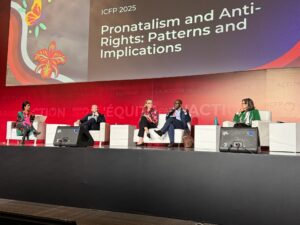
Population Institute (PI) joined global leaders, advocates, and organizations advancing sexual and reproductive health and rights for all at the International Conference on Family Planning (ICFP) in Bogotá, Colombia from November 1-7. The conversations and collaborations reaffirmed that family planning is fundamental to gender equality, climate resilience, and sustainable development. PI’s President and CEO, Kathleen Mogelgaard, participated in a Spotlight Session, “Pronatalism and Anti-Rights: Patterns and Implications,” with experts who discussed approaches to combatting current pronatalist trends. 

PI co-sponsored the conference with partner, Afrobarometer, with whom we shared a well-trafficked booth and hosted a side event. The side event, “African Perspectives on Sexual and Reproductive Health,” showcased the public release of the latest results from a recent sexual and reproductive health public opinion survey across more than 30 African countries. Afrobarometer’s CEO, Joseph Asunka, gave an overview of the highlights in conversation with four partner responders who shared the value of the findings for policymaking and program-building.

PI also co-sponsored a half-day post-conference event, “From Bogotá to Belém: SRHR as a Catalyst for Climate Justice,” and was a signatory to the “Bogotá–Belém Declaration,” which called for the centrality of sexual and reproductive health and rights and gender equity in climate dialogues, policy, and finance.   

President and CEO Kathleen Mogelgaard participated in a Spotlight Session, “Pronatalism and Anti-Rights: Patterns and Implications,” with experts who discussed approaches to combatting current pronatalist trends.

Population Institute President and CEO Featured on Bloomberg’s Big Take Podcast

Kathleen Mogelgaard, President and CEO of the Population Institute, was featured on an episode of Bloomberg News’ Big Take Asia podcast, released on October 14th, 2025, to share her thoughts on cash incentives to address low fertility rates—and whether incentivizing childbearing is necessary or appropriate in today’s world.  

To Mogelgaard, the decision making around whether and when to have children is deeply personal and depends on different factors. And it’s not always about money alone. “A big part of it is economic but there are also a number of personal decisions about timing, about spacing, about the kinds of relationships we have in our lives, about whether or not that’s the kind of future we see for ourselves and our families,” said Mogelgaard. 

Although women have been having far fewer babies on average compared to previous generations, the world’s population is still growing overall. The United Nations says only around 60 countries are seeing their populations decline, but the population in more than 120 other countries, including the United States, is still growing and appears on track to keep growing for the next 30 years. Mogelgaard sees it this way: We are not living in a period of demographic decline, but demographic diversity. 

Population Institute Plans Sponsorship of International Conference on Family Planning

In support of global efforts to achieve and safeguard universal access to family planning, sexual and reproductive healthand rightsthe Population Institute will be a sponsor of the 2025 International Conference on Family Planning (ICFP) in Bogotá, Colombia. We are honored to contribute to this important gathering of policymakers, advocates, researchers, and community leaders, and we look forward to contributing to programming, community dialogue, and strategic partnerships at ICFP. 

Don’t Destroy Birth Control: More than 75 Organizations Sign Letter to Secretary Rubio Calling for Immediate Protection of Reproductive Health Commodities

Along with more than 75 other organizations, the Population Institute signed the following letter to Secretary Rubio opposing the Trump administration’s planned destruction of nearly $10 million in contraception. 

September 12, 2025  

The Honorable Marco Rubio
Secretary
U.S. Department of State
2201 C Street Northwest
Washington, D.C. 20541 

Dear Secretary Rubio, 

The undersigned organizations write to strongly oppose the administration’s cruel and wasteful decision to incinerate nearly $10 million dollars’ worth of contraception. These supplies are safe, effective, and wanted. To destroy them would follow a destructive pattern of wasting millions in taxpayer dollars while denying people lifesaving commodities, such as the 500 tons of food that the administration let spoil earlier this year and then paid to incinerate rather than provide to hungry people. Now, the administration is at a similar crossroads with birth control already purchased by American taxpayers. These health care supplies could provide women the ability to make decisions about their own bodies, lives, and futures, but instead the administration wants to spend at least $167,000 to destroy them. 

These lifesaving supplies were intended for distribution to women and girls in sub-Saharan Africa, including those fleeing conflict or unable to afford care. Right now, women and girls around the world are desperately seeking out contraception and facing empty shelves. Meanwhile, this administration is choosing to spend taxpayer dollars to destroy effective health and medical supplies that are wanted and needed and that could save and transform lives. Many of these supplies do not expire until 2031, with the earliest expiration date in 2027, and the United States government has rejected numerous offers to buy or ship the supplies all while spreading deliberate misinformation about contraception. 

Family planning is lifesaving, time-sensitive, essential health care which enables all people to flourish. Expanding access to contraception improves women’s health, reduces maternal and child mortality, prevents HIV, and enables women and girls to pursue educational and economic opportunities. An estimated 214 million women in low- and middle-income countries who want to avoid pregnancy currently have an unmet need for modern contraception. The harm of the administration destroying $9.7 million worth of contraceptives is significant and devastating and will cause 362,000 more unintended pregnancies, 110,000 more unsafe abortions, and 718 more preventable maternal deaths. 

Despite the administration’s claims, these birth control pills, IUDs, implants, and injectables have not been destroyed. It is not too late to do the right thing. The administration must immediately halt plans to destroy these contraceptive supplies. We urge you to do everything you can to ensure lifesaving commodities, including contraception, reach people in need. 

Sincerely, 

Abortion Access Front
All* Above All
American Association of University Women (AAUW)
American Jewish World Service
American Public Health Association
Americans for Contraception
Amnesty International USA
Arizonans For Reproductive Freedom
Autistic Women & Nonbinary Network
AVAC
Bayard Rustin Center for Social Justice
California Latinas for Reproductive Justice
California National Organization for Women (CA NOW)
Center for Biological Diversity
Center of Reproductive Rights
Clearinghouse on Women’s Issues
Columbia NOW, National Organization for Women, SC
Condon Edwards Family Law
Council for Global Equality
CPIC NOW
Doctors Without Borders/Médecins Sans Frontières (MSF-USA)
EngenderHealth
Equality California
Feminist Majority
FFRF Action Fund
Fos Feminista
Gender Justice
Global Health Council
Group Care Global
Guttmacher Institute
Ibis Reproductive Health
Indivisible Northern Nevada
International Center for Research on Women
International Planned Parenthood Federation
Interruptrr
Ipas
Kent Street Coalition
League of Women Voters of St. Lawrence County, NY
Medical Students for Choice
MomsRising
MSI Reproductive Choices
National Abortion Federation
National Association of Hispanic Nurses
National Council of Jewish Women
National Latina Institute for Reproductive Justice
National Organization for Women
National Organization for Women Foundation
National Women’s Law Center
National Women’s Political Caucus
Oregonizers
PAI
Palmetto State Abortion Fund
Partners in Abortion Care
People Power United
PFLAG National
Physicians for Reproductive Health
Plan C
Planned Parenthood Federation of America
Population Connection Action Fund
Population Council
Population Institute
Positive Women’s Network-USA
Progress Florida
ProgressNow New Mexico
Reproaction
Reproductive Freedom for All
Reproductive Health Access Project
Reproductive Health Network Kenya
SHERo Mississippi
SIECUS: Sex Ed for Social Change
Silver State Equality
T-Time Support
Universal Access Project
UnmutedCo.
Voices of Health Care Action
Women’s Refugee Commission
Women’s Rights and Empowerment Network

Afrobarometer

The Population Institute is partnering with Afrobarometer, a pan-African, non-partisan research network, to support public opinion polling and analysis focused on demographic change in Africa. This partnership will enable Afrobarometer to strategically disseminate findings from a recent survey module on sexual and reproductive health and rights, women, and gender, as well as conduct additional polling on SRHR and related topics.

Population Institute Welcomes New Partnership with the Stimson Center

The Population Institute is a proud partner of the Stimson Center. The Stimson Center promotes international security and shared prosperity through applied research and independent analysis, global engagement, and policy innovation. This collaboration, a project of the Stimson Center’s Environmental Security Program called “The Shape of Our Future,” aims to advance evidence-based policy, research, and knowledge sharing to highlight the relevance of often-overlooked population trends to key U.S. and global priorities related to health, economic prosperity, and security. Key project activities will include deepening policymakers’ understanding of security concerns in the Sahel and Coastal West Africa and identifying entry points for more effective engagement across the region, strengthening congressional engagement around population dynamics, and curating a series of articles on the New Security Beat, a Stimson Center knowledge-sharing platform.

PI Bids Farewell to Stanback Fellows

The Population Institute’s Stanback Fellows have been working hard this summer, offering support to various organizational activities and working on their own independent projects. They surveyed the literature on the intersections of population and the environment, tracked mainstream media reporting on population trends, and supported outreach to new members of Congress, helping to advance the Institute’s mission and providing critical information to support informed decision-making. In addition, they attended and reported on pertinent Congressional hearings and a variety of key meetings of allies and partners. We organized a speaker series that featured many of our Senior Fellows and we hosted a Stanback Fellows Happy Hour for about 30 Stanback Fellows working in partner organizations throughout the Washington, DC metro area. Fellows participated in two writing workshops, one on writing op-eds and the other on communicating with policy audiences. We also did fun stuff too, like a Washington Nationals baseball game and a baking lesson on making knafeh, a Middle Eastern dessert. We are grateful for their many contributions this summer and wish them the best as they head back to Duke University!